
NVFR Rating Course
NVFR Rating Course
 Expand your horizons and learn to fly in the night sky!

Learning to fly at night is an important skill for any prospective Commercial pilot. It’s also useful for Private pilots who don’t want to be unnecessarily constrained by daylight hours!
The AAA NVFR course is a comprehensive course which contains:
- Instrument flight consolidation (full- and limited-panel)
- Night take-offs and landings
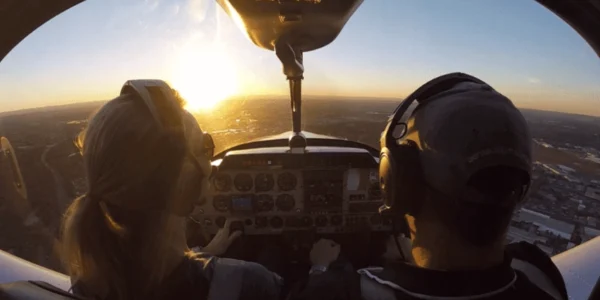
- Night visual navigation including supplemental radio navigation aids and GPS use
The instrument flight hours gained on the course can be counted toward the minimum of 10 required for the issue of a Commercial Pilot Licence, making this course an ideal stepping stone between PPL and CPL training.
You may also like...
-
Advanced Aerobatics Course
More DetailsGo beyond the basics and roll with Australia’s aerobatic champions!The Australian Aerobatic Academy’s “post-graduate” aerobatics courses are designed to expand your aerobatic repertoire and increase your skills to be capable of world-class aerobatics!
These courses build upon the AAA Aerobatic Course with additional manouevres and skills. You will begin with advanced rolling manoeuvres, followed by combination manoeuvres and ultimately low level aerobatics below 3000’ AGL as your skills and experience increase.
AAA’s advanced aerobatics courses are closely aligned with the Australian Aerobatic Club competition grades to allow graduates to compete upon completion. Aerobatic competition is the best way to provide feedback on your skills and challenge you further as you strive for perfection.
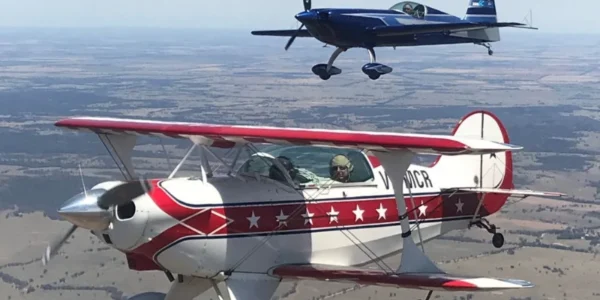
Once you have mastered the basics of aerobatic capability on the Robin 2160i, AAA offers an upgrade to the ubiquitous Pitts Special S-2A—the aircraft that has made more aerobatic champions the world over than any other aircraft! The Pitts Special is an excellent aircraft to begin your transition to higher-performance aerobatic aircraft, with it’s higher roll rate, greater horsepower and capability of sustained negative G manoeuvres.
For those wanting to pursue the upper echelons of aerobatic competition, AAA is proud to offer (by invitation only) the Extra NG – the highest performance two-seat certified aerobatic aircraft in the world! This aircraft is capable of unlimited aerobatic flight and is a weapon designed for serious aerobatic competition!
With AAA’s rich competition heritage, you can be assured of being trained by Australia’s top aerobatic instructors and pilots:
Peter Townsend, AAA’s Chief Flying Instructor, has been active in competition aerobatics for over 20 years as a competitor, coach, judge, contest organiser & contest director, having won his first national championship in the Basic category in 1998.
Cassandra Moeller, co-owner of the Academy, was the 2018 Australian Unlimited Aerobatic Champion and has been instrumental in running and organising Australian Aerobatic Club events since her first competition in 2010. Cass was also the recipient of the Matt Hall Racing (MHR) Scholarship for exemplary airmanship and sportsmanship in 2013.
Peter & Cassandra are both recipients of the FAI Paul Tissandier Diploma – awarded by the World Air Sports Federation (FAI) for their commitment to the sport of Aerobatics.
AAA has fielded a team to almost EVERY Australian competition since it’s inception, with competitors in every grade from Entry to Unlimited!
Progression through our post-graduate aerobatics courses is very much as your time, funds and desires permit. Each manoeuvre includes a briefing and aircraft are charged at standard rates. Once competency is attained you can practice to your heart’s desire until you decide to add a new figure to the sequence. As such, course costs will vary between individuals.
AAA Entry Category course:
- Barrel rolls
- Inverted flight
- Slow rolls
AAA Graduate Category course:
- Competition Spins
- Half cuban eight
- Roll-off-the-top (Immelmann)
AAA Sportsman Category course:
- Humpty-bumps & “Sharpies”
- Half reverse cuban eight
- Snap (flick) rolls
- Hesitation rolls
Low level aerobatics flight activity endorsements:
For those wishing to fly competition at the state, national and even international levels, the Australian Aerobatic Academy’s Low Level Aerobatics Courses consists of a series of tutorials and flights designed to instill confidence, safety and proficiency at performing aerobatics below 3000 feet AGL. The courses concentrate on energy management, geographic positioning and low level aerobatic sequence design & flying.
-
AAA RPL Course
More DetailsFor trainee pilots serious about safety and standards.Training safe, proficient pilots is a serious business, but that doesn’t mean you can’t have fun along the way! Not only will you loop and roll on your first lesson, during the course you will learn to take-off and land, to perform basic aerobatics, to spin and recover and to effectively recognise and respond to emergency situations. Learning these skills takes time, dedication and good instruction. Getting this process right the first time is essential when you learn to fly. Flying, like the sea, is unforgiving of the inattentive or foolish!
The Australian Aerobatic Academy’s Recreational Pilot Licence (RPL) syllabus is NOT a minimum time, minimum cost or minimum standard learn-to-fly course. It is a comprehensive course which goes beyond the minimum CASA requirements to provide you with superior aircraft handling skills. These skills will stay with you whether you choose to be an airline pilot, fly recreationally for fun, or enjoy taking your family and friends away for a weekend trip as a private pilot.
To see just how much more you get for your money with a AAA RPL course, please look at this document: AAA RPL Syllabus Comparison.
A pilot more confident and capable in the airborne environment has a greater capacity for good aeronautical decision-making, which means a safer, more proficient aviator. If your flight training is limited to the narrow envelope of the “air transport” environment, unnecessary limitations may be formed as well as an underlying fear of situations that cannot be adequately or safely explored in “standard” training aircraft incapable of basic aerobatic flight. When basic aerobatics, spinning, and upset prevention & recovery training is combined as an integral part of a learn-to-fly course, the result is a pilot fully aware of an aircraft’s capability in flight. This flight training method has been used for decades by defence forces worldwide – why should civilian pilots not also benefit from this style of training? IT WORKS!
Don’t just take our word for it… Former Sydney Aerobatic School founder & CFI Noel Kruse, author of the “Fly Better” series of books, endorses the Academy’s training methods and standards in this document. Veteran US aerobatic pilot, airshow performer and flight instructor Patty Wagstaff has written a recent article on the benefits of the Academy’s style of training: Upset Recovery Vs. Aerobatics – Plane And Pilot Magazine.
The Australian Aerobatic Academy prides itself on the standard of its instruction, as well as its personalised service and tuition. Academy instructors are experienced career instructors whose role is more of a “personal trainer” and “mentor” rather than a newly-qualified instructor trained to a minimum standard with limited operational experience. As we only employ a small number of dedicated professionals, we can guarantee the personalised service and consistency of training that larger organisations may not be able to provide.
All RPL flying lessons are conducted in the Robin 2160 – a high performance dedicated training aircraft capable of aerobatic flight. Your choice of initial training aircraft is very important. Many aircraft used for training today do not have the capability to allow practice in using the full aerodynamic envelope, leaving a gap in knowledge and experience for new pilots. It is for this reason AAA use only fully aerobatic aircraft for our initial training courses. The Robin has a cruise speed of 120 kts (215 km/h), and climb rate of 1000 ft/min. Compare this to the 40 year-old Cessna 152 or the newer Light Sport Aircraft used by other flight training schools – which have a cruise speed of around 90 kts (170 km/h) and a climb rate of 650 ft/min. This means more time is spent in the training area concentrating on learning the required skills, rather than the transit to and from the airport. Higher performance means more practice in take-offs and landings per session, which means more practice for every dollar spent!
All Sydney flying school lessons include FREE in-flight video recording facilities. Important aspects of the flight can be immediately replayed on the ground as part of the debriefing, so you don’t miss out on the vital feedback you need to improve your skills!
When making a decision on which school you choose to learn to fly with, consider this:
Learning to fly is a large commitment in time, finances and personal effort, and one must be ultimately satisfied with the ability of the selected flight training organisation to provide the level of service & quality of the qualification they purport to provide…
…What is your life, and the lives of your future passengers worth to you?